November 20, 2026
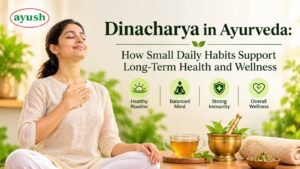
Dinacharya in Ayurveda: How Small Daily Habits Support Long-Term Health and Wellness
Healthy living is not done in spurts but in doing things regularly each day. Irregular timing of meals, lack of sleep, being on the screen for long hours, and irregular exercise may all lead to changes in how one feels throughout the day. During busy schedules, it is essential to maintain a regular routine.
The practice of Ayurveda always promotes the importance of regularity by the term ‘Dinacharya’. The term implies a regular practice of activities each day to help oneself manage the routine. It does not involve elaborate wellness rituals but emphasizes consistency in simple practices.
For individuals exploring Ayurvedic therapies in Singapore, understanding this traditional concept offers insight into how Ayurveda connects everyday lifestyle choices with long-term wellness.
The Philosophy Behind Dinacharya
In Sanskrit, the word “Dinacharya” means “daily routine.” For Ayurveda, this term is a set of practices designed to ensure more consistency in people’s daily life.
The classical system understands that the body is a system which is characterized by cycles of hunger, energy, activity, relaxation, and excretion. Keeping a relatively consistent schedule is useful for this process.
Starting the Morning With Purpose
Morning rituals hold significant value in Ayurvedic culture. A regular wake-up schedule might enable an individual to set the pace of his day by helping him avoid rushing into routine activities.
Common morning routines might consist of brushing one’s teeth, drinking water based on one’s own needs, taking care of bodily functions, and dedicating a few moments to prepare mentally for the day.
Tongue scraping and oil pulling have been traditionally part of Ayurveda. Both of these rituals must be performed with proper hygiene practices and without expecting much more from them than what can be delivered.
Food Timing and Mindful Eating
Eating habits form another important part of Dinacharya. Ayurveda traditionally places emphasis on consuming meals at reasonably consistent times and choosing food according to individual requirements.
Modern schedules often encourage rushed lunches, late dinners, frequent snacking, or skipping meals altogether. Such patterns can make it difficult to maintain a balanced nutritional routine.
A more organised approach involves allowing sufficient time for meals, choosing a varied diet, and paying attention to hunger and fullness signals.
Making Movement a Daily Priority
Physical exercise is necessary to maintain mobility, heart fitness, strength, and health in general. The practice of dinacharya recommends that one include some form of physical activity in their daily routine rather than practicing exercise occasionally. The form of physical exercise practiced will depend on the individual’s physical fitness and preference.
What is important is to be consistent, whereby one does not necessarily need to have a rigorous schedule but rather a realistic one that can easily fit into the individual’s daily activities.
Managing Mental Activity Throughout the Day
Wellness is not only about physical activities. Constant alerts, professional obligations, and personal obligations can result in no time left for mental relaxation.
Traditionally, Ayurveda suggests doing meditation, breath work, and silent thinking. All of these can give a chance to stop and concentrate on what is happening right now. Even an hour without any gadgets can help set healthy boundaries between work and leisure.
The Importance of a Consistent Night Routine
Rest is an integral component of a sustainable daily routine. Ayurveda generally suggests structuring evening activities in such a manner that the body prepares itself for rest.
Evening eating habits, extended screen time, inconsistent bed times, and engaging in stimulating activities can affect healthy sleeping practices.
An effective evening routine can involve limiting screen time, ensuring reasonable consistency in dinner time, and having a conducive sleep environment.
Adjusting Daily Practices With Seasonal Changes
Dinacharya is often linked to yet another term in Ayurveda known as Ritucharya. This is about the seasonal routine of a person.
According to Ayurveda, the environment can affect one’s appetite and activities. Therefore, everything can be changed from time to time. For instance, it is very necessary to keep hydrated when it is hot and humid.
Bringing Dinacharya Into Contemporary Singapore Life
Busy professional schedules, frequent travel, and urban lifestyles can make consistent self-care challenging. However, following Dinacharya does not require completely changing an existing routine.
People interested in Ayurvedic wellness therapy Singapore can explore traditional lifestyle guidance to understand which practices may complement their everyday habits.
A qualified Ayurvedic practitioner can provide recommendations based on individual circumstances, while conventional healthcare professionals can address specific medical and nutritional requirements.
Building Wellness Through Everyday Consistency
The concept of Dinacharya brings out a fundamental concept in Ayurveda, which is that of the close relationship between individual well-being and the organization of everyday life. Healthy meals, exercise, sleep, cleanliness, and mental rest are all practices that can together promote healthy living.
For those exploring Ayurvedic therapies in Singapore, this traditional concept provides a starting point for understanding wellness beyond individual treatments. Small habits, when practised consistently and adapted to personal needs, can become meaningful elements of a balanced lifestyle.
Ayurvedic consultant Ajesh M. BAMS earned his Bachelor Degree in Ayurveda Medicine and Surgery from Karnataka Ayurveda Medical College under Rajiv Gandhi University of Medical Science, Bangalore, Karnataka in 2011. He served in various Ayurvedic institutions in Kerala as an Ayurvedic Physician and has over 8 years of experience in Keraleeya Panchakarma Chikitsa.
allooparambil Joshy Lijo has a Diploma in Ayurveda Nursing & Panchakarma Therapy from Kuttielavil Ayurvedic Centre and Institute, Kottayam, Kerala (2006-2007). He has an experience of 12 years in Ayurveda Panchakarma therapies. He is well-trained in Kalari Marma Therapy by Unnikrishnan Gurukkal, Anjaneya Kalari, Kottayam.
Anushiya graduated with a Bachelor of Ayurvedic Medicine and Surgery (BAMS) from Ayurveda College Coimbatore, India in 2007. She underwent an intensive training and clinical practice under the mentorship and guidance of her guru ayurvedic consultant L Mahadevan Iyer, who is a highly acclaimed physician, a great Sanskrit and Vedic scholar.
She has been practicing as Asst Medical officer and subsequently, Senior Medical officer in India. Currently she is been associated with Ayush Singapore since Jan 2019. Having specialized with In-Patients & Out-patients treatment with Ayurvedic methodologies & Medicine, she will be able to ensure that you are diagnosed and treated with utmost professionalism.
With almost decade of experience in diagnosing and healing in various medical conditions using pure natural Ayurvedic methods. She is highly skilled in Detoxification and Rejuvenation Therapy. she has a lot of passion and dedication to this profession.
Her interest towards Research Fields such as Panchakarma application according to different place, Ayurvedic awareness in the world and different modalities in disease are some of the highlight.
Issac Sunithamma has a Diploma in Ayurveda Nursing and Panchakarma Therapy from Srikrishna Ayurveda Institute, Alappuzha, Kerala (2007-2008). She has over 11 years’ experience in Ayurveda Panchakarma therapies. Her record includes working as Senior Therapist, Ayur Cure Ayurveda Hospital, Hyderabad (5 years); Senior Therapist, Samkkya Ishak Integrated Center, Malacca, Malaysia (2012-2013). She is currently a therapist at Ayush Ayurvedic Center, Yishun, Singapore since 2017.
Deepesh Damodaran holds a Diploma in Ayurveda Nursing and Panchakarma Therapy (2006-2007) from Parassinikadavu Ayurveda Medical College Kannur, Kerala. In his extensive 12 years as a Ayurveda therapist, he has worked as Senior Therapist, Samkkya Ishak Integrated Health Center, Malacca, Malaysia (2012 – 2013) and, Senior Therapist at the Ayurveda health club owned by Nimr Al- Gharbia Trade & Cont. Co. L.L.C, Salalah, Sultanate of Oman (2009 – 2011). Deepesh Damodaran is currently an integral part of Ayush Ayurvedic Center, Yishun, Singpore since 2017.
Ayurvedic consultant ARCHANA T.P,BAMS,MD(AYU),is having 9 years of experince in Ayurvedic Consultation since 2011. She secured Bachelor in Ayurvedic Medicine and Surgery (Ayurvedacharya) in 2011 from JSS Ayurveda Medical college, mysore,karnataka Thereafter she completed her Post Graduate (MD in Ayurveda – kayachikitsa) from Sri Kalabhairaveswara Ayurveda Medical College and Research Centre Bangalore, karnataka in 2015. She served as junior consultant at Poornayu Ayurveda Nikethanam , Meenangaadi, kerala,india in 2012-2013. NOW she was working as an Ayurvedic consultant at Ayush Ayurveda Pte Ltd, Yishun
Ayurvedic consultant. Sudev C. BAMS, MD(Ay) is an Ayurvedic consultant with a rich consulting experience of 10 years. He secured Bachelor in Ayurvedic Medicine and Surgery (Ayurvedacharya) in 2009 from ALN Rao Memorial Ayurveda Medical College (Rajiv Gandhi University of Health Sciences, Bangalore, Karnataka). Thereafter, he completed post-graduation in Ayurveda Vachaspati from the same college. His MD was in the subject of "Kayachikitsa". Ayurvedic consultant Sudev has presented papers in various National and International seminars. He trained under Ayurvedic consultant PMS Raveendranath (Disciple of Brahmashree Vaidyamadham Valiya Narayanan Namboothiri) in Poonthottam Ayurvedashram, Kerala for hands-on treatment and Keraleeya Panchakarma Chikitsa. He served in various Ayurvedic hospitals as Chief Consultant. Previously he was working as an Ayurvedic Physician in Ayush Ayurvedic Sdn Bhd, Johor Bahru, Malaysia.
She studied Panchakarma Ayurveda Course at Centre for Indian Medicine in 2011 and secured Diploma in Ayurveda Nursing & Panchakarma Therapy from Bharat Sevak Samaj Government of India in 2013. She is having an experience of 8 years in Ayurveda Panchakarma Therapies in India and in Malaysia. She joined Ayush on 2019.
He secured Certificate in Spa Services from Singapore Workfoce Skills Qualificatios at Spatec Academy in 2015.He is having an experience of 18 years in Ayurveda Panchakarma Therapies in Singapore and Malaysia. He also secured Diploma in Medicina Herbalism from Royal Institute of Health Sciences Mumbai in 2000, Diploma in Ayurveda Panchakarma Therapies at Prasanthy Institute of Ayurvedic studies in 2000. Joined Ayush on 2015
Ayurvedic consultant Ram Prasad graduated with a degree in Ayurvedic Medicine and Surgery (BAMS) from Bharatiyar University, Tamil Nadu, India in 1990. Meanwhile he undertook private study of ancient treatises with V.V Vasudevan, Director Arsha Yoga Vidya Peetham, Coimbatore from 1986 till 1989, besides clinical study with Vaidyamadham Cheriya Narayanan Naboodiri, the esteemed Ayurveda Master, from 1990 till 1991. In 2005 he completed a Certificate in Advanced Clinical Hypnotherapy with the Academy of Applied Hypnosis, Sydney. He is currently pursuing a course on Mind-Body medicine – Mind-Body Psychology with Greg Neville.
Ayurvedic consultant Raveendranath graduated from Ayurveda College Coimbatore with a Bachelor in Ayurvedic Medicine and Surgery (BAMS) in 1988. In 1989 he founded Poonthottam Ayurvedasram. He was initiated into Ayurveda by his father who is a renowned Sanskrit scholar belonging to a family of ardent believers of Ayurveda. To know more about ayurvedic consultant Raveendranath and Poonthottam
Ayurvedic consultant Ramesh R Varier graduated in the first rank from Madras University with a degree in Ayurvedic Medicine and Surgery (BAMS) In 1985. After a brief stint as tutor at Ayurveda College Coimbatore, he joined AVN the family owned Ayurvedic institution. To know more about Ayurvedic consultant Varier and AVN click here