
July 10, 2026
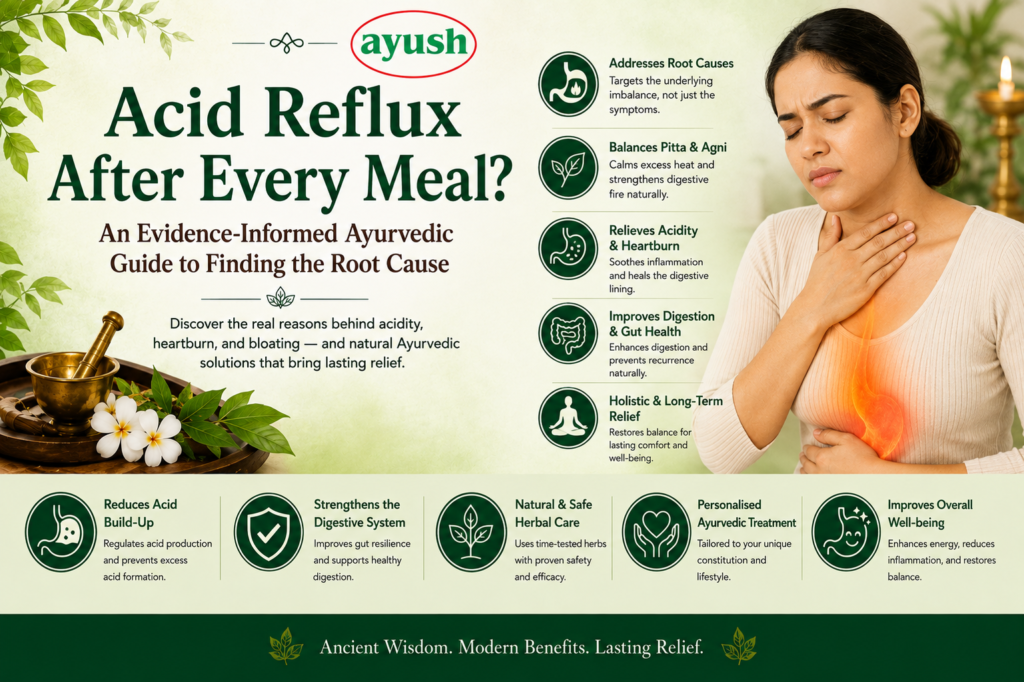
Millions of people take antacids daily. The tablet provides relief within minutes. An hour later the burning returns. Another tablet. Another hour. The cycle repeats indefinitely without any reduction in the frequency or severity of episodes. Ayurvedic Treatments In Singapore at Ayush Ayurveda receive clients caught in exactly this cycle, people who have been managing acid reflux symptomatically for months or years without anyone genuinely investigating why it keeps occurring after every meal.
Antacid dependency is not a treatment outcome. It is a management compromise that leaves the underlying cause entirely unaddressed while suppressing the symptom that would otherwise motivate genuine investigation and correction.
Why Acid Reflux Occurs: The Physiology Most Explanations Oversimplify
Most explanations of acid reflux describe it as excess stomach acid rising into the oesophagus. This description is technically accurate in one specific scenario. It is, however, an incomplete account of the full range of mechanisms that produce post-meal burning and regurgitation in different individuals.
Ayurvedic Treatments In Singapore practitioners encounter several distinct reflux mechanisms that require different therapeutic responses. Genuine hyperchlorrhydria, excess acid production, is one pattern. Lower oesophageal sphincter weakness that allows normal or even below-normal acid quantities to reflux inappropriately is another. Delayed gastric emptying that traps food and acid within the stomach beyond the normal processing window creates a third pattern where reflux occurs hours after eating rather than immediately following meals.
Using trusted Ayurvedic treatment Singapore assessment, the pattern that each person exhibits can be determined by looking at the timing of the symptoms after meals, the nature of the discomfort, the foods that often cause symptoms and the time of day the symptoms occur. This pattern differentiation is what is not established by generic antacid prescriptions, and is the foundation of diagnosis.
The Ayurvedic Understanding of Amlapitta
Ayurvedic Treatments In Singapore classify acid reflux presentations within the framework of Amlapitta, literally translated as sour Pitta, a classical Ayurvedic diagnostic category that encompasses the full range of acid-related digestive disorders. The sophistication of the Amlapitta classification lies in its recognition that not all presentations carry the same underlying dosha dynamics.
Urdhva Amlapitta, upward-moving sour Pitta, is associated with the classical reflux symptoms of upward movement of sour towards the throat. This pattern is disturbed Samana Vata, the digestive Vata subdosa, which regulates the upward movement of the food in the stomach, which allows it to move upwards when it is disturbed. This pattern needs to be treated at both the Pitta excess and the Vata disturbance (that allows the acid quality to ascend) using trusted ayurvedic treatment singapore.
Adhogami Amlapitta (downward moving sour Pitta) causes symptoms in the lower digestive system, not the oesophagus, and includes acidic stools, lower abdominal cramping and the inflammatory bowel pattern which the continued excess of Pitta in the small intestine can cause. When a client is experiencing upper and lower symptoms at the same time they’re demonstrating the total effect that a Pitta imbalance has had on them and it’s not contained in one place.
Singapore’s Dietary Landscape and Its Acid Reflux Contribution
Ayurvedic Treatments In Singapore practitioners working with Singapore’s population observe consistent dietary patterns that contribute directly to Amlapitta prevalence in this specific population. Singapore’s food culture, while extraordinary in its variety and quality, presents several consistent Pitta-aggravating patterns that reflux sufferers regularly consume without recognising their contribution to their own symptoms.
When the lunch break was short and rushed, the Hawker centre meals were not digested in the optimal way, because of the lack of a peaceful and parasympathetic environment during digestion. When the digestive enzymes are inhibited by the sympathetic nervous system, they cannot function properly, leading to poor digestion and inadequate nutrient absorption.Under pressure, the dominant sympathetic nervous system directly inhibits digestive enzyme secretion and reduces gastric motility, resulting in poor digestion and nutrient absorption. The digestion is incomplete, leading to fermentation and acid build-up that is seen as reflux after feeding.
Trusted ayurvedic treatment singapore dietary advice is specific instead of the generic advice to take your time when eating. It can be as simple as meal timing that creates real thirty minutes between meals and work activity, eliminating drinks of cold beverages with meals to “cool down” Agni during its most active processing time, or reducing the number of fermented, spiced and fried food combinations offered through Singapore’s diverse cuisine that Singaporeans cannot resist.
Herbal Interventions That Address Amlapitta Without Suppression
Ayurvedic Treatments In Singapore herbal protocols for acid reflux aim to correct the underlying Pitta-Agni imbalance rather than suppress acid production in the way that proton pump inhibitors do. This distinction matters clinically because appropriate stomach acid is essential for protein digestion, mineral absorption, and the maintenance of the stomach’s bacterial defence environment. Long-term acid suppression creates nutritional deficiencies and increases susceptibility to specific gastrointestinal infections, consequences that Ayurvedic treatment specifically avoids by working with Agni rather than against it.
Shatavari, Asparagus racemosus, forms the cornerstone of most Amlapitta herbal prescriptions at Ayush Ayurveda. Its demulcent properties soothe inflamed oesophageal and gastric mucosa while its cooling Pitta-pacifying action addresses the excess heat quality driving acid hypersecretion. Unlike antacids that produce immediate but temporary neutralisation, Shatavari’s mucosal healing action produces cumulative improvement that strengthens with consistent use over four to eight weeks.
The antidotal and anti-inflammatory activity of Yashtimadhu (glycyrrhiza glabra, Licorice root) has been studied in numerous clinical trials in gastro-oesophageal reflux and peptic ulcer disease with its mucoprotective activity. Its carbenoxolone components cause an increase in mucus production which protects and coats the lining of the gastric and oesophageal tracts, thereby helping to limit the damage to the lining due to the effects of acid on the walls over time. The use of Yashtimadhu rich formulations in trusted Ayurvedic treatment Singapore includes a modification of the duration for the treatment to prevent any possible mineralocorticoid side effects caused by very prolonged use of high doses of Licorice.
Panchakarma’s Role in Resolving Established Amlapitta
When acid reflux has been present for years rather than months, herbal treatment and dietary correction alone often produce incomplete resolution. The Pitta accumulation has become deeply established within the gastric and intestinal tissue. Ayurvedic Treatments In Singapore Panchakarma protocols for established Amlapitta use Virechana, therapeutic purgation, as the primary intervention for systematically clearing the accumulated Pitta from its site of pathological concentration.
The Virechana procedure draws accumulated Pitta from the liver and small intestine, its primary sites of excess, through the lower digestive tract for elimination. This directional clearance addresses the source of acid excess rather than merely managing its manifestation at the oesophageal level. Clients completing a properly conducted Virechana programme for Amlapitta at Ayush Ayurveda typically experience the most significant and durable reduction in reflux frequency following this procedure.
Post-Virechana dietary management is critical to preventing re-accumulation of the Pitta that the procedure has cleared. Trusted Ayurvedic treatment Singapore programmes at Ayush Ayurveda include structured post-Panchakarma dietary guidance that rebuilds digestive strength progressively while maintaining the Pitta-balanced internal environment that treatment has established.
Ayurvedic consultant Ajesh M. BAMS earned his Bachelor Degree in Ayurveda Medicine and Surgery from Karnataka Ayurveda Medical College under Rajiv Gandhi University of Medical Science, Bangalore, Karnataka in 2011. He served in various Ayurvedic institutions in Kerala as an Ayurvedic Physician and has over 8 years of experience in Keraleeya Panchakarma Chikitsa.
allooparambil Joshy Lijo has a Diploma in Ayurveda Nursing & Panchakarma Therapy from Kuttielavil Ayurvedic Centre and Institute, Kottayam, Kerala (2006-2007). He has an experience of 12 years in Ayurveda Panchakarma therapies. He is well-trained in Kalari Marma Therapy by Unnikrishnan Gurukkal, Anjaneya Kalari, Kottayam.
Anushiya graduated with a Bachelor of Ayurvedic Medicine and Surgery (BAMS) from Ayurveda College Coimbatore, India in 2007. She underwent an intensive training and clinical practice under the mentorship and guidance of her guru ayurvedic consultant L Mahadevan Iyer, who is a highly acclaimed physician, a great Sanskrit and Vedic scholar.
She has been practicing as Asst Medical officer and subsequently, Senior Medical officer in India. Currently she is been associated with Ayush Singapore since Jan 2019. Having specialized with In-Patients & Out-patients treatment with Ayurvedic methodologies & Medicine, she will be able to ensure that you are diagnosed and treated with utmost professionalism.
With almost decade of experience in diagnosing and healing in various medical conditions using pure natural Ayurvedic methods. She is highly skilled in Detoxification and Rejuvenation Therapy. she has a lot of passion and dedication to this profession.
Her interest towards Research Fields such as Panchakarma application according to different place, Ayurvedic awareness in the world and different modalities in disease are some of the highlight.
Issac Sunithamma has a Diploma in Ayurveda Nursing and Panchakarma Therapy from Srikrishna Ayurveda Institute, Alappuzha, Kerala (2007-2008). She has over 11 years’ experience in Ayurveda Panchakarma therapies. Her record includes working as Senior Therapist, Ayur Cure Ayurveda Hospital, Hyderabad (5 years); Senior Therapist, Samkkya Ishak Integrated Center, Malacca, Malaysia (2012-2013). She is currently a therapist at Ayush Ayurvedic Center, Yishun, Singapore since 2017.
Deepesh Damodaran holds a Diploma in Ayurveda Nursing and Panchakarma Therapy (2006-2007) from Parassinikadavu Ayurveda Medical College Kannur, Kerala. In his extensive 12 years as a Ayurveda therapist, he has worked as Senior Therapist, Samkkya Ishak Integrated Health Center, Malacca, Malaysia (2012 – 2013) and, Senior Therapist at the Ayurveda health club owned by Nimr Al- Gharbia Trade & Cont. Co. L.L.C, Salalah, Sultanate of Oman (2009 – 2011). Deepesh Damodaran is currently an integral part of Ayush Ayurvedic Center, Yishun, Singpore since 2017.
Ayurvedic consultant ARCHANA T.P,BAMS,MD(AYU),is having 9 years of experince in Ayurvedic Consultation since 2011. She secured Bachelor in Ayurvedic Medicine and Surgery (Ayurvedacharya) in 2011 from JSS Ayurveda Medical college, mysore,karnataka Thereafter she completed her Post Graduate (MD in Ayurveda – kayachikitsa) from Sri Kalabhairaveswara Ayurveda Medical College and Research Centre Bangalore, karnataka in 2015. She served as junior consultant at Poornayu Ayurveda Nikethanam , Meenangaadi, kerala,india in 2012-2013. NOW she was working as an Ayurvedic consultant at Ayush Ayurveda Pte Ltd, Yishun
Ayurvedic consultant. Sudev C. BAMS, MD(Ay) is an Ayurvedic consultant with a rich consulting experience of 10 years. He secured Bachelor in Ayurvedic Medicine and Surgery (Ayurvedacharya) in 2009 from ALN Rao Memorial Ayurveda Medical College (Rajiv Gandhi University of Health Sciences, Bangalore, Karnataka). Thereafter, he completed post-graduation in Ayurveda Vachaspati from the same college. His MD was in the subject of "Kayachikitsa". Ayurvedic consultant Sudev has presented papers in various National and International seminars. He trained under Ayurvedic consultant PMS Raveendranath (Disciple of Brahmashree Vaidyamadham Valiya Narayanan Namboothiri) in Poonthottam Ayurvedashram, Kerala for hands-on treatment and Keraleeya Panchakarma Chikitsa. He served in various Ayurvedic hospitals as Chief Consultant. Previously he was working as an Ayurvedic Physician in Ayush Ayurvedic Sdn Bhd, Johor Bahru, Malaysia.
She studied Panchakarma Ayurveda Course at Centre for Indian Medicine in 2011 and secured Diploma in Ayurveda Nursing & Panchakarma Therapy from Bharat Sevak Samaj Government of India in 2013. She is having an experience of 8 years in Ayurveda Panchakarma Therapies in India and in Malaysia. She joined Ayush on 2019.
He secured Certificate in Spa Services from Singapore Workfoce Skills Qualificatios at Spatec Academy in 2015.He is having an experience of 18 years in Ayurveda Panchakarma Therapies in Singapore and Malaysia. He also secured Diploma in Medicina Herbalism from Royal Institute of Health Sciences Mumbai in 2000, Diploma in Ayurveda Panchakarma Therapies at Prasanthy Institute of Ayurvedic studies in 2000. Joined Ayush on 2015
Ayurvedic consultant Ram Prasad graduated with a degree in Ayurvedic Medicine and Surgery (BAMS) from Bharatiyar University, Tamil Nadu, India in 1990. Meanwhile he undertook private study of ancient treatises with V.V Vasudevan, Director Arsha Yoga Vidya Peetham, Coimbatore from 1986 till 1989, besides clinical study with Vaidyamadham Cheriya Narayanan Naboodiri, the esteemed Ayurveda Master, from 1990 till 1991. In 2005 he completed a Certificate in Advanced Clinical Hypnotherapy with the Academy of Applied Hypnosis, Sydney. He is currently pursuing a course on Mind-Body medicine – Mind-Body Psychology with Greg Neville.
Ayurvedic consultant Raveendranath graduated from Ayurveda College Coimbatore with a Bachelor in Ayurvedic Medicine and Surgery (BAMS) in 1988. In 1989 he founded Poonthottam Ayurvedasram. He was initiated into Ayurveda by his father who is a renowned Sanskrit scholar belonging to a family of ardent believers of Ayurveda. To know more about ayurvedic consultant Raveendranath and Poonthottam
Ayurvedic consultant Ramesh R Varier graduated in the first rank from Madras University with a degree in Ayurvedic Medicine and Surgery (BAMS) In 1985. After a brief stint as tutor at Ayurveda College Coimbatore, he joined AVN the family owned Ayurvedic institution. To know more about Ayurvedic consultant Varier and AVN click here