
September 05, 2026
The eyes are continuously exposed to various factors such as screen time, artificial lights, dust, changing environmental conditions, and visual stress. Engaging oneself in reading, driving, using computers, or mobile phones for several hours can make eye comfort essential for daily health. There are many specialized Ayurvedic therapies for eye care that include Netra Tharpanam.
Netra Tharpanam is an ancient Ayurvedic method of eye care wherein the retention of an appropriate medicated preparation made from ghee is done for a specified duration around the eyes. It should be noted that what makes the treatment unique is not the use of ghee alone but its retention around the eye area.
For people exploring Ayurvedic therapies in Singapore, understanding how this traditional technique is performed and why ghee retention is central to the procedure can provide a clearer picture of what to expect.
Netra Tharpanam is an Ayurvedic treatment that involves the exterior and is mainly related to providing nutrition to the eye area. The term “Tharpanam” is usually connected to the notion of providing nutrition or satisfaction, while “Netra” stands for the eyes.
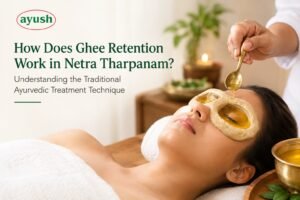
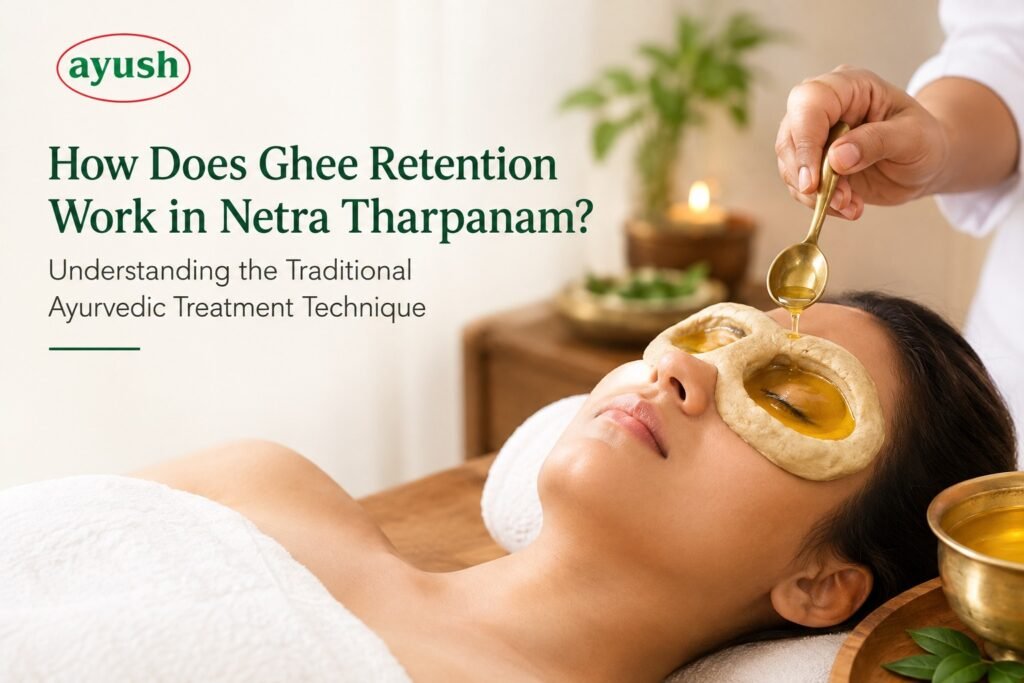
In this process, a certain boundary is made around the eyes through the use of appropriate dough material. After that, medicated ghee is filled into this boundary, which then stays in place around the closed eyes for a definite period of time.
This procedure is done in a regulated manner, rather than just filling ghee on the eyes. It is due to the reason that retaining the ghee is the major aspect of the traditional process.
Ghee has a significant role in various formulations used in traditional Ayurveda. In Netra Tharpanam, appropriate preparation of ghee with herbal medicines is kept over the eyes rather than being removed immediately.
This enclosure helps the formulation to stay in contact with the adjoining area for a certain period of time. From the perspective of traditional Ayurveda, such long-term exposure outside is treated differently from a temporary exposure.
This preparation depends on the patient’s condition. Consequently, Netra Tharpanam is not done using regular kitchen ghee or any mixture of it.
One of the most unique features in Netra Tharpanam involves the creation of a safe barrier for the eyes. A dough-like barrier is usually created around the eye area in order to form a small reservoir.
This arrangement must be sturdy enough in order to prevent the ghee from leaking out. The individual will normally be in a comfortable and relaxed position during the treatment process.
When the barrier is in place, the chosen ghee is administered. It is important to ensure that the ghee used in the process is at the right temperature. The process is delicate due to the sensitivity of the eye and thus it should be done by someone well conversant with the procedure.
Following the placement of the ghee inside the made boundary, the eyes of the individual remain gently closed. The ghee stays inside the designated spot throughout the period as determined by the practitioner.
The process might initially be strange since the eye area is surrounded by the kept substance. But generally, the atmosphere is set in a soothing environment.
After reaching the prescribed period, the ghee is then slowly removed. Following that, the surrounding substance will be taken off and the eye area will be cleaned as per the instructions of the practitioner.
The period of retention does not always apply to everyone. It might vary based on the individual’s needs and the type of formulation used.
One aspect that is relevant in Netra Tharpanam is temperature. Ghee needs to be used in the correct temperatures and not too hot or too cold.
As the product is going to be used around the eyes, temperature helps to ensure that the process is comfortable and safe. This is one reason why it is recommended to leave the process to professionals.
This is because even though the product is all-natural, the application process needs to be done in the correct way.
Netra Tharpanam is traditionally used as part of Ayurvedic eye-care routines. Its primary appeal comes from the specialised attention given to the eye region and the use of medicated ghee in a controlled setting.
Some people may seek the procedure as part of a broader approach to eye-area relaxation, particularly when their lifestyle involves prolonged visual concentration. However, traditional wellness claims should not be confused with established medical treatment.
Netra Tharpanam should not be promoted as a cure for refractive errors, infections, glaucoma, cataracts, or other ophthalmic conditions. Anyone experiencing persistent eye pain, vision changes, redness, discharge, injury, or other concerning symptoms should consult an appropriate eye-care professional.
Although Netra Tharpanam is a traditional external procedure, it may not be suitable in every situation. A preliminary consultation can help identify whether the therapy is appropriate for a particular individual.
People should inform the practitioner about existing eye conditions, recent eye procedures, allergies, infections, medications, or unusual symptoms before beginning treatment.
A professional may recommend postponing the procedure when the eye area requires medical evaluation or when the individual has circumstances that could make the therapy unsuitable.
Anyone considering specialised Ayurvedic eye therapies can benefit from professional guidance before selecting a procedure. An Ayurveda consultation Singapore service can provide an opportunity to discuss lifestyle factors, individual concerns, and whether a particular Ayurvedic approach is suitable.
A good consultation should involve more than simply recommending a treatment. The practitioner should explain the procedure, discuss the ingredients involved, address relevant precautions, and provide realistic expectations.
Netra Tharpanam is sometimes misunderstood as simply placing ghee over the eyes. In reality, the retention method involves several controlled steps.
The surrounding enclosure, preparation of the medicated ghee, positioning of the individual, retention period, removal process, and post-treatment care all form part of the traditional procedure.
This structured approach is what separates Netra Tharpanam from casual home applications. The therapy is a specialised Ayurvedic procedure and should be treated accordingly.
Following Netra Tharpanam, the practitioner may provide simple instructions regarding exposure to bright light, screen use, washing the face, or other activities immediately after the session.
Because recommendations can vary according to the preparation and individual circumstances, it is better to follow the specific advice provided by the practitioner rather than applying generic aftercare rules.
Netra Tharpanam demonstrates how Ayurveda approaches specialised body care through carefully controlled procedures rather than relying solely on individual ingredients. Ghee retention is central to the technique, creating a temporary reservoir around the closed eyes and allowing the selected preparation to remain in place for a defined period.
For individuals researching Ayurvedic therapies in Singapore, learning about the procedure beforehand can make the experience more informed and comfortable. Professional assessment is especially important because the eyes are highly sensitive and should always be treated with appropriate care.
Ayurvedic consultant Ajesh M. BAMS earned his Bachelor Degree in Ayurveda Medicine and Surgery from Karnataka Ayurveda Medical College under Rajiv Gandhi University of Medical Science, Bangalore, Karnataka in 2011. He served in various Ayurvedic institutions in Kerala as an Ayurvedic Physician and has over 8 years of experience in Keraleeya Panchakarma Chikitsa.
allooparambil Joshy Lijo has a Diploma in Ayurveda Nursing & Panchakarma Therapy from Kuttielavil Ayurvedic Centre and Institute, Kottayam, Kerala (2006-2007). He has an experience of 12 years in Ayurveda Panchakarma therapies. He is well-trained in Kalari Marma Therapy by Unnikrishnan Gurukkal, Anjaneya Kalari, Kottayam.
Anushiya graduated with a Bachelor of Ayurvedic Medicine and Surgery (BAMS) from Ayurveda College Coimbatore, India in 2007. She underwent an intensive training and clinical practice under the mentorship and guidance of her guru ayurvedic consultant L Mahadevan Iyer, who is a highly acclaimed physician, a great Sanskrit and Vedic scholar.
She has been practicing as Asst Medical officer and subsequently, Senior Medical officer in India. Currently she is been associated with Ayush Singapore since Jan 2019. Having specialized with In-Patients & Out-patients treatment with Ayurvedic methodologies & Medicine, she will be able to ensure that you are diagnosed and treated with utmost professionalism.
With almost decade of experience in diagnosing and healing in various medical conditions using pure natural Ayurvedic methods. She is highly skilled in Detoxification and Rejuvenation Therapy. she has a lot of passion and dedication to this profession.
Her interest towards Research Fields such as Panchakarma application according to different place, Ayurvedic awareness in the world and different modalities in disease are some of the highlight.
Issac Sunithamma has a Diploma in Ayurveda Nursing and Panchakarma Therapy from Srikrishna Ayurveda Institute, Alappuzha, Kerala (2007-2008). She has over 11 years’ experience in Ayurveda Panchakarma therapies. Her record includes working as Senior Therapist, Ayur Cure Ayurveda Hospital, Hyderabad (5 years); Senior Therapist, Samkkya Ishak Integrated Center, Malacca, Malaysia (2012-2013). She is currently a therapist at Ayush Ayurvedic Center, Yishun, Singapore since 2017.
Deepesh Damodaran holds a Diploma in Ayurveda Nursing and Panchakarma Therapy (2006-2007) from Parassinikadavu Ayurveda Medical College Kannur, Kerala. In his extensive 12 years as a Ayurveda therapist, he has worked as Senior Therapist, Samkkya Ishak Integrated Health Center, Malacca, Malaysia (2012 – 2013) and, Senior Therapist at the Ayurveda health club owned by Nimr Al- Gharbia Trade & Cont. Co. L.L.C, Salalah, Sultanate of Oman (2009 – 2011). Deepesh Damodaran is currently an integral part of Ayush Ayurvedic Center, Yishun, Singpore since 2017.
Ayurvedic consultant ARCHANA T.P,BAMS,MD(AYU),is having 9 years of experince in Ayurvedic Consultation since 2011. She secured Bachelor in Ayurvedic Medicine and Surgery (Ayurvedacharya) in 2011 from JSS Ayurveda Medical college, mysore,karnataka Thereafter she completed her Post Graduate (MD in Ayurveda – kayachikitsa) from Sri Kalabhairaveswara Ayurveda Medical College and Research Centre Bangalore, karnataka in 2015. She served as junior consultant at Poornayu Ayurveda Nikethanam , Meenangaadi, kerala,india in 2012-2013. NOW she was working as an Ayurvedic consultant at Ayush Ayurveda Pte Ltd, Yishun
Ayurvedic consultant. Sudev C. BAMS, MD(Ay) is an Ayurvedic consultant with a rich consulting experience of 10 years. He secured Bachelor in Ayurvedic Medicine and Surgery (Ayurvedacharya) in 2009 from ALN Rao Memorial Ayurveda Medical College (Rajiv Gandhi University of Health Sciences, Bangalore, Karnataka). Thereafter, he completed post-graduation in Ayurveda Vachaspati from the same college. His MD was in the subject of "Kayachikitsa". Ayurvedic consultant Sudev has presented papers in various National and International seminars. He trained under Ayurvedic consultant PMS Raveendranath (Disciple of Brahmashree Vaidyamadham Valiya Narayanan Namboothiri) in Poonthottam Ayurvedashram, Kerala for hands-on treatment and Keraleeya Panchakarma Chikitsa. He served in various Ayurvedic hospitals as Chief Consultant. Previously he was working as an Ayurvedic Physician in Ayush Ayurvedic Sdn Bhd, Johor Bahru, Malaysia.
She studied Panchakarma Ayurveda Course at Centre for Indian Medicine in 2011 and secured Diploma in Ayurveda Nursing & Panchakarma Therapy from Bharat Sevak Samaj Government of India in 2013. She is having an experience of 8 years in Ayurveda Panchakarma Therapies in India and in Malaysia. She joined Ayush on 2019.
He secured Certificate in Spa Services from Singapore Workfoce Skills Qualificatios at Spatec Academy in 2015.He is having an experience of 18 years in Ayurveda Panchakarma Therapies in Singapore and Malaysia. He also secured Diploma in Medicina Herbalism from Royal Institute of Health Sciences Mumbai in 2000, Diploma in Ayurveda Panchakarma Therapies at Prasanthy Institute of Ayurvedic studies in 2000. Joined Ayush on 2015
Ayurvedic consultant Ram Prasad graduated with a degree in Ayurvedic Medicine and Surgery (BAMS) from Bharatiyar University, Tamil Nadu, India in 1990. Meanwhile he undertook private study of ancient treatises with V.V Vasudevan, Director Arsha Yoga Vidya Peetham, Coimbatore from 1986 till 1989, besides clinical study with Vaidyamadham Cheriya Narayanan Naboodiri, the esteemed Ayurveda Master, from 1990 till 1991. In 2005 he completed a Certificate in Advanced Clinical Hypnotherapy with the Academy of Applied Hypnosis, Sydney. He is currently pursuing a course on Mind-Body medicine – Mind-Body Psychology with Greg Neville.
Ayurvedic consultant Raveendranath graduated from Ayurveda College Coimbatore with a Bachelor in Ayurvedic Medicine and Surgery (BAMS) in 1988. In 1989 he founded Poonthottam Ayurvedasram. He was initiated into Ayurveda by his father who is a renowned Sanskrit scholar belonging to a family of ardent believers of Ayurveda. To know more about ayurvedic consultant Raveendranath and Poonthottam
Ayurvedic consultant Ramesh R Varier graduated in the first rank from Madras University with a degree in Ayurvedic Medicine and Surgery (BAMS) In 1985. After a brief stint as tutor at Ayurveda College Coimbatore, he joined AVN the family owned Ayurvedic institution. To know more about Ayurvedic consultant Varier and AVN click here